
Automotive electronic circuit boards: a new resource for strategic urban mining and a growth opportunity for the ELV sector in Italy
The end-of-life vehicle (ELV) recycling and treatment sector is undergoing a period of profound scientific, technological and regulatory transformation. On-board electronics once considered a complex components destined for unsorted shredding, have emerged as the resource with the highest value density in the entire vehicle dismantling supply chain. This is partly due to the push towards the recovery of automotive electronics introduced by European directives.
The transition to the new European ELV Regulation (2024/2026) imposes binding targets of at least 95 per cent total recovery and 85 per cent material recycling, calculated by vehicle weight. One of the most significant operational changes is the requirement to remove electronic circuit boards (PCBs) before the vehicle is sent for shredding.
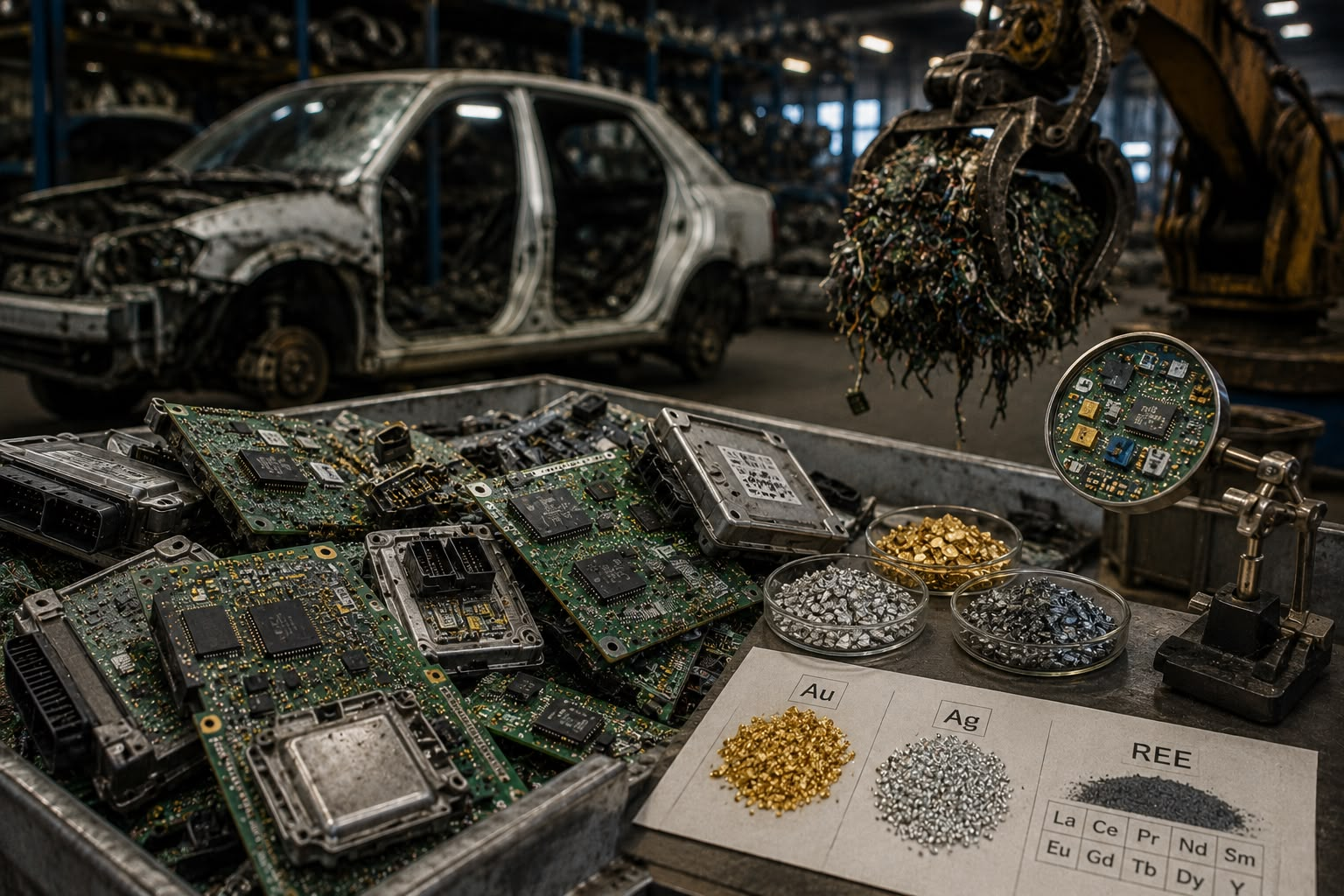
This ensures that components such as engine control units (ECUs), safety modules (ADAS), infotainment systems and power converters are removed, preventing precious metals and critical raw materials (CRMs) from being lost or irreparably contaminated in the scrap ‘fluff’.
A modern mid-range car contains around 15 components fitted with electronic circuit boards; this figure rises to over 50 in luxury models. In Italy, for example, where between 0.9 and 1.3 million vehicles are scrapped each year, electronic components generate an estimated annual flow of between 4,500 and 7,800 tonnes of PCBs from the automotive sector. A significant proportion of these must be correctly processed to extract the precious metals.
Although automotive circuit boards (WPCBs) account for only 3 per cent to 6 per cent of the weight of global electronic waste, they contain over 40% of the total metal value. They therefore represent valuable resources to be recovered – a mine on four wheels that must not be overlooked.
In Italy, the total value of this waste stream is estimated to range between 180 and 350 million euros per year, with a central estimate of 250 million euros. This is within a European market which is expected to reach 8.39 billion euros by 2030.
Gold accounts for around 80 per cent of the total economic value contained in automotive circuit boards, while copper and silver account for the remaining 20 per cent.
This scenario represents a significant challenge for Italy, particularly for its ELV supply chain. However, it also presents a valuable business opportunity that can be realised by investing in appropriate processes and effective technologies to streamline the extraction and refining of precious metals. This would maximise the value of this type of waste and transform it into a strategic resource.
Choosing the best process and the right technology partner is crucial in this process. This is why, at Osai Green Tech, we offer our clients our proprietary technology and expertise in the treatment and recovery of PCBs from WEEE, including for the ELV sector and consequently for the recovery of automotive PCBs.
Unlike PCBs from WEEE (waste electrical and electronic equipment, such as household appliances and general IT equipment), automotive PCBs have a very high concentration of gold relative to their weight. Traditional treatment processes involve completely crushing the board, followed by chemical or thermal treatment. These processes require high reagent consumption and generate large quantities of waste, thereby reducing yields, recycling efficiency, and consequently, the economic return.
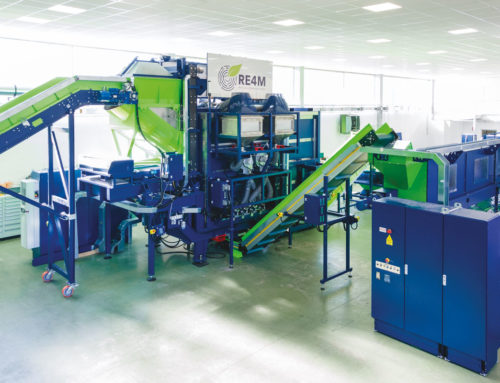
The process innovation introduced by our Re4M plant is based on patented controlled thermo-mechanical detachment technology, which enables electronic components to be separated from circuit boards prior to treatment of the two fractions
The thermo-mechanical pre-treatment instantly separates high-value metals (such as Au and Ag) from the high-volume matrix (such as Cu in bare circuit boards), enabling the efficient recovery of precious metals while reducing operating costs by cutting demand for chemical reagents and lowering energy consumption and waste disposal costs. Furthermore, every fraction is utilised, including the non-metallic residues (e.g. epoxy resins and glass fibre), which can be recovered and used as reinforcing fillers in building materials and concrete. This virtually eliminates the need for landfill disposal and increases the overall level of circularity.
In Italy, over 1,500 companies are involved with end-of-life vehicles (ELVs) in various capacities, and many of these are small businesses handling low volumes. However, there are also large groups with several hundred employees and a processing capacity exceeding 50 vehicles per day.
Osai Green Tech can offer this highly fragmented sector a range of solutions aimed at recovering value from extracted automotive PCBs.
- Re4M PCB 2000 Performance (full-scale solution): a pre-treatment plant for WPCBs intended for hydrometallurgical processing, with a processing capacity of 2,000 kg/day. It is ideal for processing high volumes of material, including WEEE, for the subsequent chemical-physical extraction of precious metals.
- Re4M PCB 2000 Easy (full-scale solution): a pre-treatment plant for WPCBs (component removal from boards only), with a processing capacity of 2,000 kg/day. Ideal for processing high volumes of material, including WEEE, whilst maximising the value of this initial stage.
- Re4M PCB 100 (entry-level solution): with a processing capacity of 100 kg/day, this solution is ideal for small treatment centres (processing 10–20 cars/day) that whish to maximise the recovery value of automotive PCBs before reselling the recovered material to specialist refiners.
All of the solutions offered by Osai Green Tech, as listed above, involve the pre-treatment of PCBs originating from both the automotive sector and WEEE (Waste Electrical and Electronic Equipment), making the investment versatile for these two applications. Furthermore, the modular design of the plants enables you to select the desired level of refinement and consequently the extraction of various fractions. You can limit the process to separating components from the boards for subsequent sale, thereby increasing the value of the separated material. Alternatively, you can carry out further pre-treatment and mechanical refining steps, such as the extraction of copper and other metals from the boards, or even the chemical refining of precious metals using hydrometallurgical processes.
Applying pre-treatment to separate components from automotive circuit boards in end-of-life vehicles (ELVs) transforms car dismantlers into primary suppliers of ‘urban mines’.
If you are an ELV centre, contact us to find out more about our solutions and start optimising your resources and operations.